
The Science
The "Fingerprint" of Your Eye
The cornea is the clear, dome-shaped front window of your eye. It provides about 70% of the eye's focusing power. For you to see clearly, the cornea must be perfectly smooth and evenly curved.
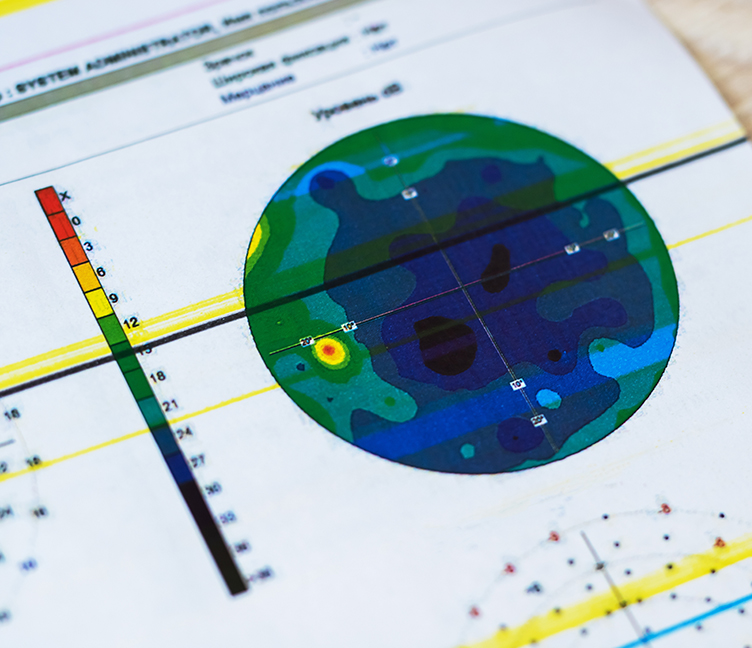
Corneal Topography is a non-invasive medical imaging technique used to map the microscopic hills and valleys of this surface. Just like a topographical map of a mountain range shows elevation, our topographer projects illuminated rings onto the eye to generate a highly detailed, 3D color-coded map of your cornea's curvature.
Beyond the Slit Lamp
Standard eye exams rely on a slit-lamp microscope, which only allows the doctor to see the surface. Topography gives us objective, mathematical data, measuring thousands of points on the eye in a matter of seconds. It reveals microscopic irregularities long before they cause symptoms.
Crucial for Disease Diagnosis
Topography is the absolute gold standard for diagnosing and tracking the progression of corneal diseases.
Keratoconus causes the cornea to thin and bulge outward into a cone shape. Topography is the only way to catch this condition in its earliest stages, allowing us to intervene with treatments like Corneal Cross-Linking (CXL) before permanent vision loss occurs.
Learn More
While regular astigmatism is shaped like a football and easily fixed with glasses, irregular astigmatism means the eye has multiple, uneven curves. Topography pinpoints the exact location and severity of these irregularities.
While regular astigmatism is shaped like a football and easily fixed with glasses, irregular astigmatism means the eye has multiple, uneven curves. Topography pinpoints the exact location and severity of these irregularities.
Learn More
Mastering the Contact Lens Fit
If you have ever tried contact lenses that were uncomfortable, shifted when you blinked, or popped out easily, it is likely because the curvature of the lens did not match the unique curvature of your eye.
Dr. Fouladian utilizes corneal topography data to custom-design specialty contact lenses that fit with microscopic perfection.
Scleral Lenses
For patients with Keratoconus or severe dry eye, scleral lenses must perfectly vault over the diseased tissue. Topography tells us exactly how high the "arch" of the lens needs to be so it rests safely on the white of the eye without touching the fragile cornea.
Orthokeratology (Ortho-K)
These nighttime lenses physically reshape the eye to correct myopia. Topography is absolutely mandatory to design the intricate reverse-geometry curves of the Ortho-K mold and to verify that the reshaping is occurring evenly overnight.
Eliminating the Guesswork
In the past, fitting specialty lenses involved placing multiple "trial lenses" on the eye to see what fit best through trial and error. With advanced topography mapping, Dr. Fouladian enters your eye's exact dimensions into a computer algorithm to custom-lathe a lens specifically for you.
View Medical Lenses
View Medical Lenses
Precision Care Starts Here
If you struggle with blurry vision, astigmatism, or uncomfortable contacts, it's time to see the whole picture. Schedule a comprehensive exam with topography mapping.