
Why Co-Management Matters
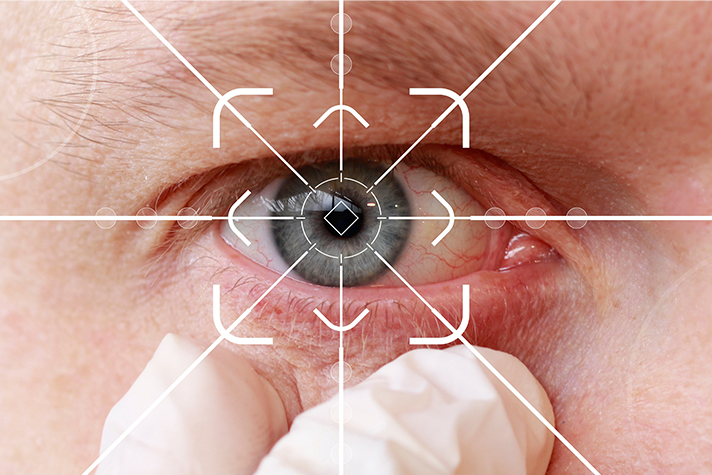
Choosing to have eye surgery is a major decision. As your primary eye care provider, Dr. Jilber Fouladian acts as your unbiased advocate. He does not perform the surgery himself, which means his only goal is to find the safest procedure and the best surgeon for your specific eyes.
Pre-Op Evaluation We measure your corneal thickness, curvature, and tear film to determine if you are truly a good candidate.
Surgeon Selection We refer you only to surgeons with proven track records for your specific condition.
Post-Op Care Dr. Fouladian manages your recovery (1-day, 1-week, 1-month visits) to ensure proper healing without you needing to travel to the surgery center.
Cataract Surgery & Premium IOLs
Removing the cloudy lens and replacing it with a high-tech artificial lens.
Standard vs. Laser-Assisted (FLACS)
Standard Surgery: The surgeon uses a manual blade to create incisions. It is effective and typically covered by insurance.
Laser-Assisted (FLACS): A femtosecond laser makes precise, computer-guided incisions and softens the cataract. This offers unmatched precision for astigmatism correction and lens placement, often leading to sharper visual outcomes.

Lens Options (IOLs)
Standard Monofocal: Corrects vision at one distance (usually far). You will need glasses for reading.
Toric IOL: Specifically designed to correct astigmatism, providing sharper distance vision without glasses.
Multifocal / EDOF: Advanced lenses that split light to provide vision at distance, intermediate, and near. Ideal for patients wanting to be glass-free.
Light Adjustable Lens (LAL): The only IOL that can be customized after surgery using UV light treatments to fine-tune your prescription to perfection.
Laser Vision Correction
Which procedure is right for you?
LASIK
Best For: Fast Recovery
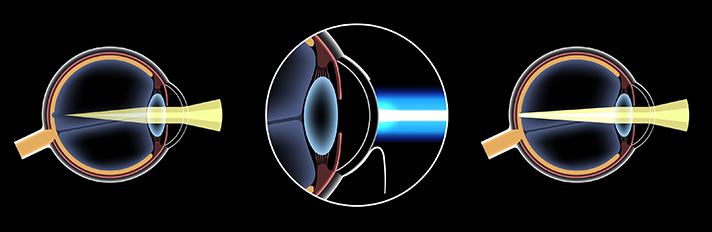
A flap is created on the cornea, and a laser reshapes the tissue underneath.
- 24-hour recovery
- Little to no pain
- Requires adequate corneal thickness
PRK
Best For: Thin Corneas / Athletes
No flap is created. The laser treats the surface of the cornea directly.
- Safer for contact sports
- Good for thin corneas
- 3-5 day recovery time
ICL (EVO Visian)
Best For: High Prescriptions
An Implantable Collamer Lens is placed inside the eye behind the iris. Does not remove corneal tissue.
- Reversible procedure
- Excellent night vision
- Corrects extreme myopia
Refractive Lens Exchange (RLE)
The "Permanent" Solution for 40+
For patients over 40 who are frustrated with reading glasses or bifocals, LASIK may not be the best long-term option. RLE involves replacing the eye's natural lens with a premium multifocal IOL before a cataract develops.
This procedure corrects distance and near vision simultaneously and has a major lifelong benefit: you will never develop cataracts in the future.
45-55
Ideal Age Range
- Corrects Presbyopia
- Eliminates Cataract Risk
- Lifetime Stability
Am I a Candidate?
Schedule a pre-operative evaluation with Dr. Fouladian to discover which procedure is safest for your eyes.