
The "Dandruff" of the Eye
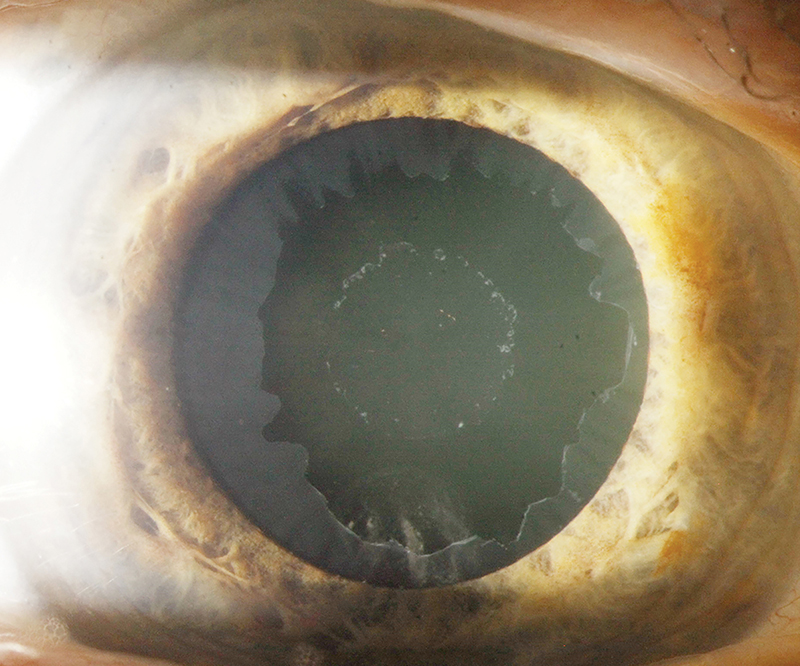
Pseudoexfoliation Syndrome (PXF) is an age-related systemic condition where abnormal, flaky, whitish material—resembling microscopic dandruff—is continuously produced and deposited inside the eye.
While the material itself is painless and does not directly blur your vision, where it lands causes two major, sight-threatening problems. It primarily accumulates on the front of the eye's natural lens and inside the eye's delicate drainage system.
The Silent Condition
The Two Major Risks
Why Dr. Fouladian monitors this condition so aggressively.
Aggressive Glaucoma
The eye constantly produces fluid that must drain through a microscopic meshwork. In PXF, the "dandruff" flakes rub off the lens and flow directly into this drain, clogging it like hair in a shower grate.
Why it's dangerous: This causes Pseudoexfoliative Glaucoma. Unlike normal glaucoma where pressure rises slowly, PXF glaucoma can cause rapid, severe pressure spikes, leading to faster and more aggressive optic nerve damage and permanent blindness.
Complex Cataract Surgery
Your eye's natural lens is held in place by tiny, delicate "springs" called zonules. The PXF material settles on these zonules, making them incredibly weak and brittle. Furthermore, the pupil often refuses to dilate fully.
Why it matters: If you need cataract surgery, weak zonules increase the risk of the lens dropping into the back of the eye during the procedure. Knowing you have PXF beforehand allows the surgeon to prepare specialized tools (like Capsular Tension Rings) to ensure a safe, successful surgery.
Proactive Management
Diagnosis & Treatment Protocol
How Dr. Fouladian Detects It
The Dilated Exam
PXF is almost impossible to diagnose if the pupil is small. Dr. Fouladian uses dilating drops to open the pupil wide, revealing a classic "bullseye" or "target" pattern of flaky material resting on the front of the eye's natural lens.
Gonioscopy
Once detected on the lens, Dr. Fouladian uses a specialized mirrored lens (Gonioscopy) to look directly into the hidden drainage angle of the eye, checking for pigment and flake buildup that signals impending glaucoma.
How We Protect You
If you are diagnosed with PXF but your eye pressure is normal, you become a "Glaucoma Suspect." We will monitor your eye pressure, optic nerve health (via OCT scans), and visual fields every 6 months.
If pressure begins to rise, Dr. Fouladian will aggressively treat it. Treatment may include prescription pressure-lowering drops or a referral to a Glaucoma Specialist for SLT (Selective Laser Trabeculoplasty), a gentle laser procedure that helps clean out the clogged drain and restore fluid flow.
Protect Your Future Vision
Routine dilated eye exams are the only way to catch silent conditions like Pseudoexfoliation before they cause irreversible damage.
TEXT FOR APPT